Monthly deposits and compounding: match the periods
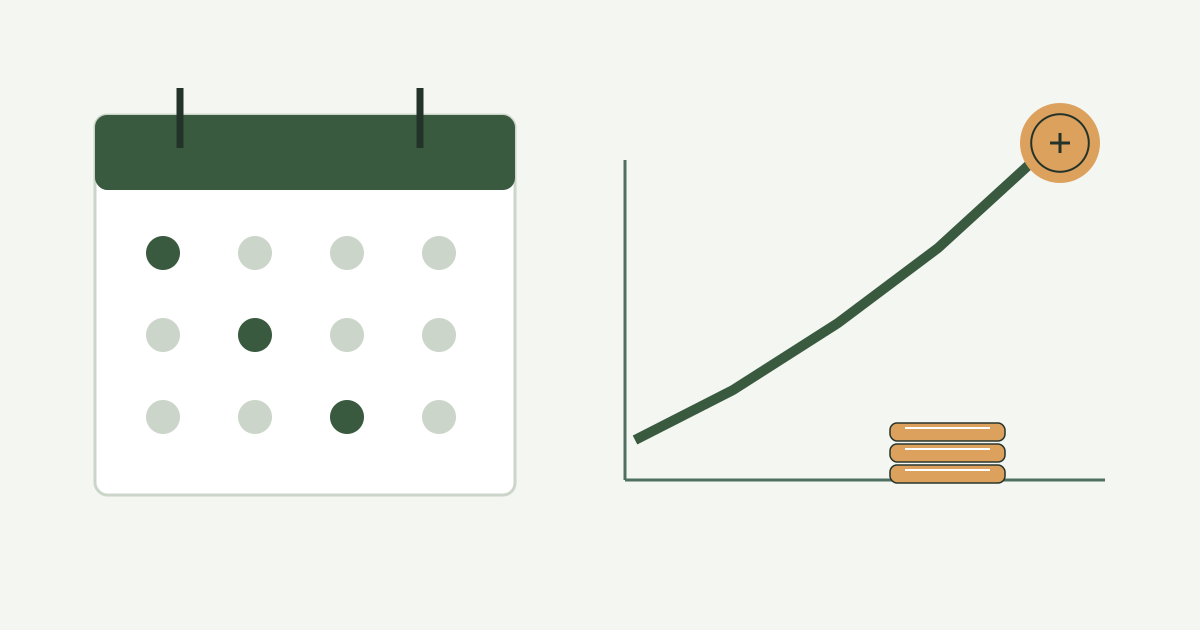
Saving 100 every month adds 1,200 a year. Saving 100 once a year adds 100. I check that difference before comparing monthly deposits and compounding, because a change in payment frequency can easily overwhelm a change in the interest calculation.
Separate depositing money from crediting growth
A contribution adds new cash. Compounding describes how a nominal annual rate is converted into a growth factor. The two events need not have the same frequency. A person may compare monthly savings using an annual growth convention, or quarterly contributions under a monthly nominal rate. That is why the calculator has two independent frequency controls.
The recurring-contribution field is the amount of each payment. It is not automatically an annual contribution budget divided by the selected frequency. If you enter 100 and select monthly contributions, you add 1,200 per whole year. Change to annual contributions while keeping 100, and you add only 100. A lower final amount in that comparison does not isolate a compounding effect.
| Frequency | Payments per year | Payment for 1,200 annual cash |
|---|---|---|
| Annual | 1 | 1,200.00 |
| Half-yearly | 2 | 600.00 |
| Quarterly | 4 | 300.00 |
| Monthly | 12 | 100.00 |
| 52 equal periods | 52 | 1,200 / 52 before rounding |
| 365 equal periods | 365 | 1,200 / 365 before rounding |
Convert the nominal rate into its annual factor
For nominal annual rate r and m compounding periods per year, the annual growth factor is (1 + r/m)^m. A 6% nominal rate with monthly compounding uses a monthly rate of 0.5%; its annual factor is 1.005^12, approximately 1.0616778. The corresponding effective annual rate is approximately 6.16778%, not exactly 6%.
With annual compounding, the same 6% nominal input produces an annual factor of 1.06. With continuous compounding it produces exp(0.06), approximately 1.0618365. These are different conventions applied to the same nominal-rate number. If you have an effective annual yield, select annual compounding and enter that yield as the annual rate to reproduce its yearly growth factor in this model. Entering the same yield with monthly compounding would count compounding again. This equivalence assumes fixed rates and equal intervals; it does not reproduce a bank’s accrual rules.
Derive growth per contribution interval
Once the annual factor is known, the model takes its d-th root for d equal contribution intervals per year. For an annual factor of 1.05 and monthly contributions, the monthly factor is 1.05^(1/12). Its period rate is approximately 0.407412%, rather than 5% / 12 = 0.416667%. Twelve such equivalent intervals reproduce the chosen annual factor.
This is an interpolation convention for equal mathematical intervals. It does not promise that a bank applies that rate to a deposit arriving between crediting dates. Actual accrual, posting dates, day-count conventions and eligibility rules can differ. I keep that limitation beside the result because choosing independent frequencies should not imply knowledge of a particular account’s contract.
Check a mixed-frequency example
Start with 5,000 and add 200 at the end of each monthly interval for five whole years. Assume a 5% nominal annual rate with annual compounding. The starting-balance component is 5,000 × 1.05^5. There are 60 deposits; use q = 1.05^(1/12) − 1 for their factor. The deposit component is 200 × (1.05^5 − 1) / q.
Together those components give 19,944.16 after rounding. Cash supplied is 5,000 + 200 × 60 = 17,000, leaving 2,944.16 of modelled gain. The annual schedule uses the same equivalent-period convention and finishes at the same unrounded balance as the headline. If an implementation uses a different monthly rate in its table, matching the last row becomes an immediate diagnostic check.
| Component | Expression |
|---|---|
| Annual factor | 1.05 |
| Monthly growth factor | 1.05^(1/12) |
| Contribution count | 12 × 5 = 60 |
| Original principal future value | 5,000 × 1.05^5 |
| Contribution future value | 200 × (1.05^5 − 1) / (1.05^(1/12) − 1) |
| Total, rounded | 19,944.16 |
Keep continuous growth and discrete deposits distinct
Continuous compounding applies exponential growth to balances between contributions. It does not turn a monthly contribution into a continuous cash stream. With nominal annual rate r and d payments per year, the equal contribution-interval factor is exp(r/d), and the N discrete payments still form a geometric series. Beginning timing adds one such interval to each contribution.
An approximation that uses r/12 for monthly contributions while growing principal with exp(r × years) mixes conventions. It can also cause the annual schedule to disagree with the result if the table grows the original principal monthly instead of continuously. The calculator uses one annual logarithmic growth parameter for principal, contributions and every annual checkpoint.
Recognize the boundaries of equal periods
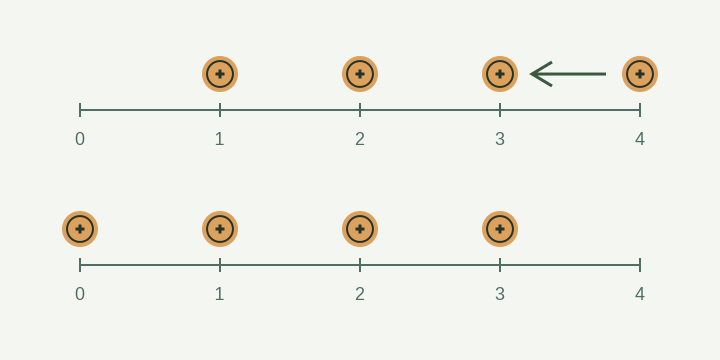
The selections 52 and 365 describe equal intervals within one model year. They are not a dated weekly payment calendar or a count of days in a particular leap year. The whole-year duration makes the number of payments unambiguous: d multiplied by years. There are no fractional end payments or automatically prorated contributions.
The annual table includes an initial row and every whole year through the selected duration. Displayed money is rounded to the currency’s usual decimal units, but formulas keep unrounded values between rows. Slight differences between a sum of rounded row gains and a rounded final gain can therefore occur. Currency changes formatting, not the numeric scenario or any exchange rate.
Compare one assumption at a time
I would keep the annual cash budget fixed when exploring contribution frequency, keep the nominal-rate convention fixed when exploring timing, and inspect the effective annual rate when comparing compounding. These are different questions. Combining all three changes at once makes it difficult to attribute the result to any one setting.
The calculator treats the annual rate as an assumption. Negative values explore a constant decline; they do not model a realistic variable sequence of market returns. Taxes, fees, withdrawals and changing deposits are excluded. To compare frequencies fairly, keep the yearly contribution budget fixed and change just one setting at a time.
- Define a yearly contribution budget if that is what you want to keep constant.
- Divide it by the selected contribution frequency before entering the payment amount.
- Choose the nominal annual rate and compounding convention separately.
- Read the effective annual and equivalent contribution-period rates.
- Check that the last annual row matches the projected total.
Use the future value calculator, then compare beginning and end payment timing or nominal and real amounts. The Investor.gov calculator also separates monthly contributions from compounding frequency.
The Shri Ram College of Commerce finance notes explain equal-payment annuities. The calculation here is general information, not financial advice or a promised return.
Quick answers
Is the monthly contribution field an annual total?
No. It is the amount of each contribution; monthly selection makes 12 contributions per whole year.
Can I enter an effective annual yield as a monthly nominal rate?
For the same yearly growth factor, choose annual compounding and enter the effective annual yield. Entering that yield with monthly compounding would count compounding again. The model still assumes fixed rates and equal payment intervals.
Are 365 contributions actual dated bank deposits?
No. They are 365 equal mathematical intervals per model year. Actual calendars and bank contracts may differ.