Future value after inflation: nominal and real amounts

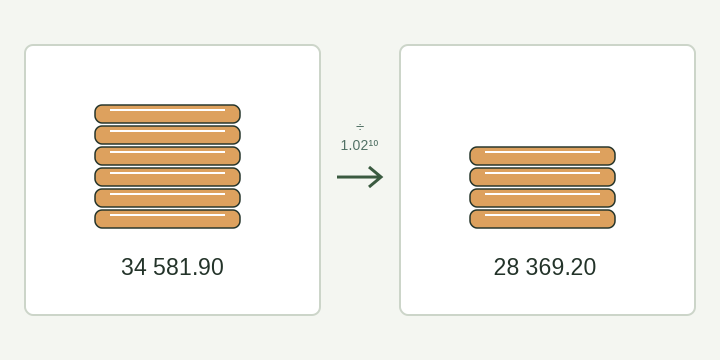
At 2% inflation over ten years, a future balance of 34,581.90 has the purchasing power of about 28,369.20 today. The account amount stays the same; the inflation adjustment tells you what that amount could buy.
Nominal value is the amount in future currency units
The nominal future value is the projected number of currency units at the end of the selected duration. It combines the grown starting balance and the grown recurring contributions under the selected nominal-rate convention. Changing the inflation input does not change that nominal calculation, payment count or contributed cash.
A nominal amount can be useful for comparing stated cash targets, but it does not explain what those future units might buy. If prices grow over the duration, more currency may be needed to obtain the same basket of goods. An inflation-adjusted calculation translates the final amount into starting-period purchasing-power units under one explicit constant-inflation assumption.
Divide by the cumulative inflation factor
For constant annual inflation i and duration t, the cumulative factor is (1 + i)^t, with i expressed as a decimal. Real ending value is nominal future value divided by that factor. The calculation is multiplicative: subtracting a percentage multiplied by the number of years is only an approximation and becomes increasingly different as the duration grows.
For 2% inflation over 10 years, the factor is 1.02^10, approximately 1.2189944. A nominal ending value of 34,581.902020969 therefore corresponds to 28,369.204529351 in starting-period purchasing power, displayed as 28,369.20 in a two-decimal currency. The division uses the unrounded nominal result, so rounding the headline first does not become a hidden input to the real-value calculation.
| Annual inflation | 10-year price factor | Real value of 34,581.902020969 |
|---|---|---|
| 0% | 1 | 34,581.90 |
| 2% | 1.2189944 | 28,369.20 |
| 5% | 1.6288946 | 21,230.29 |
Read all three chart lines without mixing their meanings
The nominal balance line shows the projected account amount. The contributed-cash line shows original principal plus nominal contributions made so far. The inflation-adjusted line shows each annual balance expressed in starting-period purchasing power. The lines can overlap, especially at zero inflation or zero growth, but they remain different quantities.
The contributed-cash line is not inflation-adjusted in this tool. Comparing the real ending value with that nominal cash total is therefore not an exact real investment profit calculation. Contributions arrive at different times; an exact purchasing-power accounting for every cash flow would require discounting each flow under its own timing. The tool deliberately reports the simpler real ending balance instead of labelling that mixed comparison a real return.
Keep nominal contributions fixed unless the model says otherwise
A recurring contribution of 100 remains 100 in every period here. Positive inflation reduces the purchasing power of later nominal contributions, but it does not automatically increase their amount. An inflation-indexed contribution plan would use changing payments and needs a different calculation. The equal-payment formula must not be described as though it included that adjustment.
The same rule applies to a starting balance: it is entered once at time zero. Taxes, fees, withdrawals and changing investment returns are absent. You choose a constant annual inflation rate. Positive and negative values are supported; neither changes the contributions or the nominal account balance.
Convert a purchasing-power goal into a nominal target
The target field in the calculator is nominal. If your hypothetical goal is 30,000 in starting-period purchasing power after 10 years with 2% assumed inflation, first compute the future nominal equivalent: 30,000 × 1.02^10 = 36,569.832599843, approximately 36,569.83. Keep adequate precision in that conversion before solving the recurring contribution.
Entering 30,000 directly instead would ask for 30,000 future nominal units, a different and lower purchasing-power goal under positive inflation. I label the target convention explicitly because the two numbers can both look like plausible targets. The tool’s required-contribution calculation uses the nominal target, then rounds the recurring amount upward to the currency’s displayed smallest unit.
Avoid subtracting inflation from a nominal rate by habit
Subtracting inflation from a rate can provide a rough mental comparison, but it is not the same operation as deflating the final balance. Even for a lump sum with an effective annual growth rate j, the exact constant annual real growth factor is (1 + j) / (1 + i), not 1 + j − i. And a nominal annual rate with multiple compounding periods is not necessarily that effective rate j.
The calculator first derives the growth convention chosen for the nominal projection, then deflates the ending amount separately. Equal payments also complicate any attempt to call a single difference between two annual rate inputs the overall return on contributed cash. I prefer keeping the balance and purchasing-power outputs separate rather than offering an attractive but ambiguous real-return percentage.
| Output | What it describes | What it does not establish |
|---|---|---|
| Nominal future value | Projected future currency units | A guaranteed outcome |
| Total contributed cash | Starting amount plus all nominal payments | An inflation-adjusted cost basis |
| Modelled gain or loss | Nominal balance minus nominal contributed cash | A forecast after taxes and fees |
| Inflation-adjusted value | Ending amount in starting-period purchasing power | A second credited bank balance |
| Required target contribution | Equal payment for a nominal target under assumptions | A personal savings recommendation |
Use a reproducible assumption check
Before comparing inflation scenarios, hold the starting balance, contribution amount, timing, rate and frequencies fixed. Change only inflation. The nominal total and total contributed cash should remain identical, while the real value changes. If the nominal balance moves, the implementation is mixing the two calculations or another input has changed.
Then inspect the annual table rather than relying only on the final chart point. Every row is calculated under the same model, and the final nominal row matches the headline. Copying or downloading keeps the inflation assumption with the result. That matters because a real value with no stated inflation rate and duration is difficult to interpret later.
- Calculate the nominal scenario with clearly labelled hypothetical rates.
- Choose a separate annual inflation assumption.
- Read the real value as starting-period purchasing power.
- Convert a real goal to a nominal target before using the target field.
- Keep assumptions, currency code and limitations with any shared result.
Explore the future value calculator, annuity timing and independent contribution frequencies. The Investor.gov comparison uses an estimated rate rather than a promised future return. These examples are general information, not financial advice.
Quick answers
Does inflation reduce the credited balance in this model?
No. It changes the purchasing-power comparison; the nominal balance is calculated independently.
Does the tool increase contributions with inflation?
No. Recurring contributions stay fixed nominal amounts. Inflation-indexed payments require a different model.
Is the target amount nominal or real?
Nominal. Convert a starting-period purchasing-power goal into a future nominal amount before entering it.